Overview
The Quantum Information Playground was developed at the request of Dr. Mario Szegedy during my time at Rutgers University. It was designed as an educational tool for a quantum computing lecture series hosted for high school students in New Jersey.
The goal was to create an intuitive, interactive environment where users could build simple quantum circuits, apply gates, and observe state evolution step-by-step — making abstract quantum information concepts visually concrete.
System Design
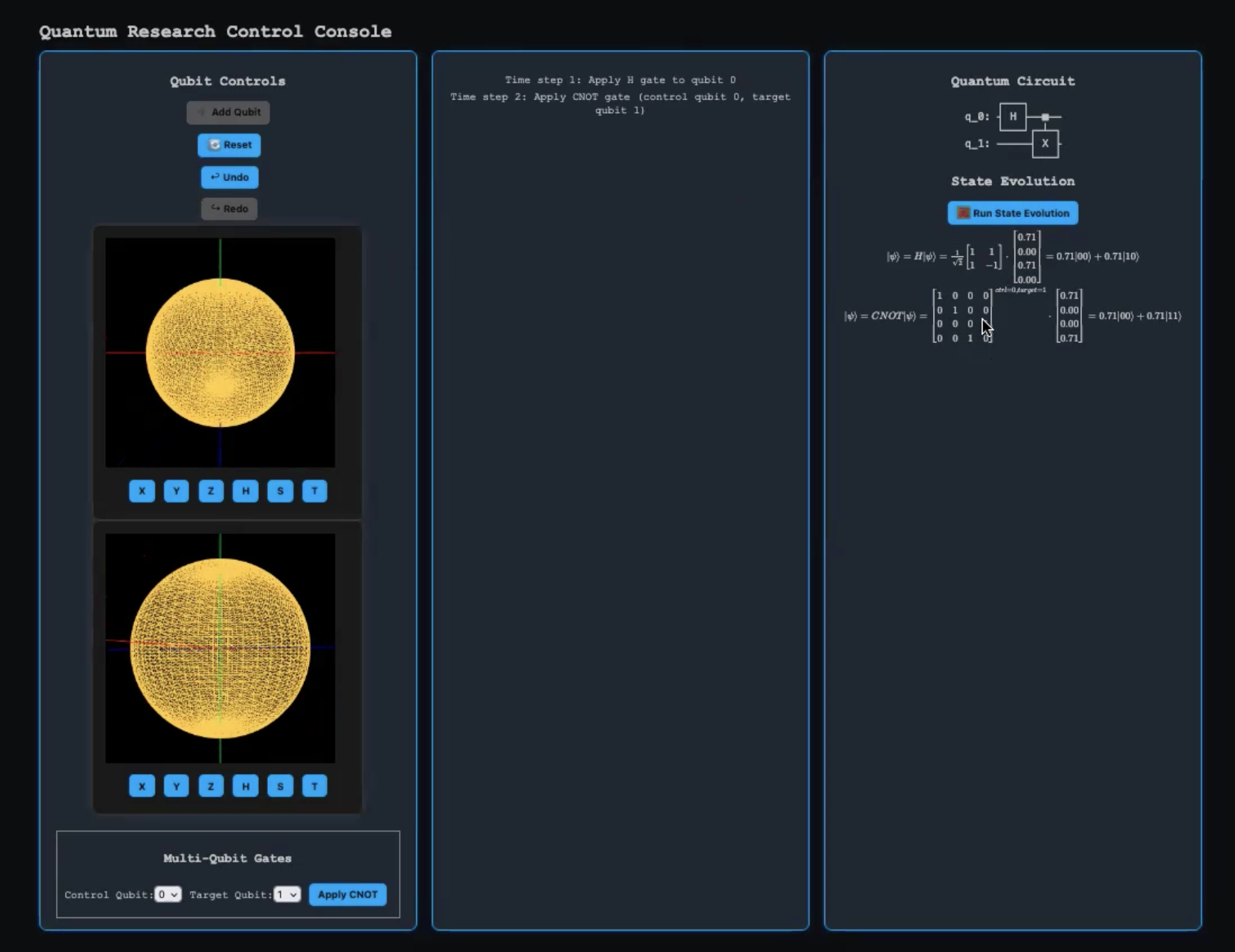
The interface is structured into three coordinated panels:
• Qubit Controls: Add qubits, apply single-qubit gates (X, Y, Z, H, S, T),
and construct multi-qubit operations such as CNOT.
• Protocol Tracker: Displays the ordered sequence of applied operations,
allowing users to understand time evolution step-by-step.
• Circuit & State Evolution Panel: Visualizes the quantum circuit and
computes the resulting state vector after each operation.
Conceptual Focus
The tool emphasizes foundational quantum information ideas:
• Superposition via Hadamard operations
• Entanglement generation with CNOT gates
• State-vector evolution under unitary transformations
• Matrix representation of quantum gates
• Classical feedforward logic in simple protocols
By connecting circuit diagrams directly to matrix operations and resulting state vectors, the system bridges the gap between visual intuition and mathematical formalism.
What I Learned
This project strengthened my ability to translate abstract quantum theory into interactive computational systems. It required careful handling of matrix operations, state normalization, and consistent time-step tracking.
More importantly, it reinforced how powerful well-designed tools can be in communicating complex physical ideas — especially in educational settings.